 Legal News
Kerala High Court Toddy Shop Judgment 2026
Kerala High Court Toddy Shop Judgment 2026: Full Case
Kerala High Court Strikes Down Ban on Women Working in Toddy Shops: Know the Complete Judgment, Constitutional Provisions and Legal Implications
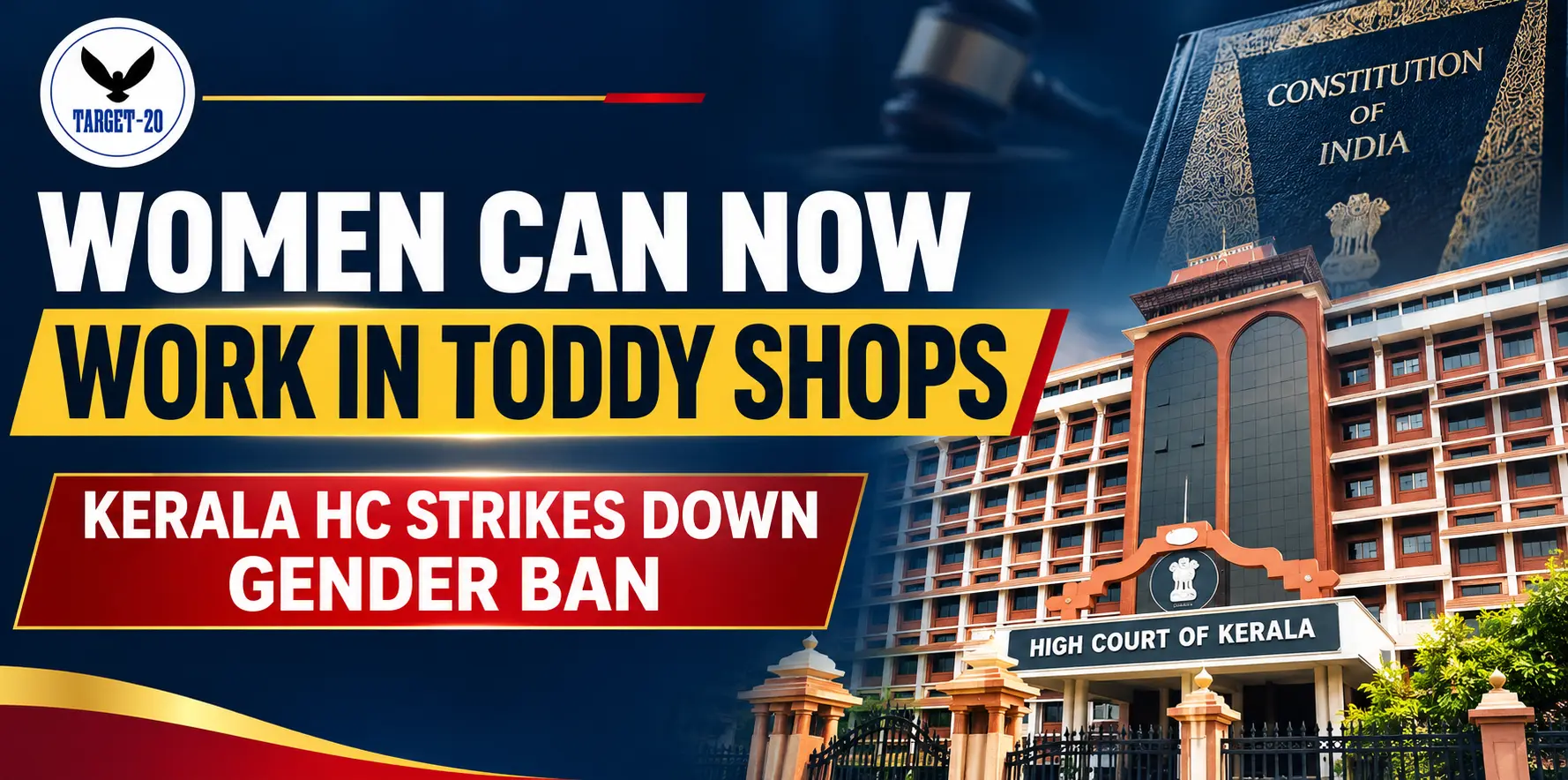
The Kerala High Court has delivered an important judgment on gender equality and women's right to employment by declaring unconstitutional a rule that prohibited women from working in toddy shops. The decision highlights an important constitutional principle: women cannot be denied employment opportunities in the name of protection and safety.
In Sophy v. State of Kerala & Others (2026), the Kerala High Court struck down Rule 7(37) of the Kerala Abkari Shops Disposal Rules, 2002. The provision prohibited the employment of women in any capacity in toddy shops across the state.
The judgment was delivered by Justice Gopinath P. on August 5, 2026. The matter came into wider public attention following reports published on October 29, 2026.
The case began when a woman named Sophy approached the High Court after her request for compassionate appointment at a toddy shop was rejected following the death of her husband. The Court held that the State cannot protect women by excluding them from employment. Instead, it must create safe working conditions that allow women to choose their profession freely.
This judgment is particularly important for understanding Article 14, Article 15, Article 19(1)(g), Article 21, gender equality and constitutional morality. It is also relevant for candidates preparing for UP PCS-J, Rajasthan Judiciary, MP ADPO, Bihar APO and other State Judiciary examinations.
Kerala High Court Toddy Shop Judgment 2026: Case Details
Before discussing the facts and legal reasoning, let us look at the important details of the judgment.
| Particulars | Details |
|---|---|
| Case Name | Sophy v. State of Kerala & Others |
| Court | Kerala High Court |
| Case Number | W.P.(C) No. 27762 of 2024 |
| Judgment Date | 5 August 2026 |
| Judge | Justice Gopinath P. |
| Case Citation | 2026:KER:59925 |
| Challenged Provision | Rule 7(37) |
| Relevant Rules | Kerala Abkari Shops Disposal Rules, 2002 |
| Final Decision | Rule 7(37) declared unconstitutional |
| Constitutional Provisions | Articles 14, 15, 19 and 21 |
Background of the Case: Why Did Sophy Approach the Kerala High Court?
The case concerns the employment rights of a woman from Irinjalakuda in Thrissur district, Kerala.
Sophy's husband, K. J. Kunjupalu, was employed as a manager at Toddy Shop No. 148 in Ponjanam, under the Irinjalakuda Range.
On May 20, 2024, her husband passed away. Following his death, Sophy sought employment at the same toddy shop on compassionate grounds.
Her request was based on an industrial settlement that provided for employment opportunities to eligible family members in certain circumstances following the death of an employee.
However, her request was rejected because of Rule 7(37) of the Kerala Abkari Shops Disposal Rules, 2002.
The rule clearly prohibited the employment of women in any capacity in toddy shops.
Sophy believed that refusing her employment merely because she was a woman was discriminatory and violated her fundamental rights under the Indian Constitution.
She therefore approached the Kerala High Court and challenged the constitutional validity of Rule 7(37).
Her petition raised an important legal question: Can the government prohibit women from working in a particular industry simply because it considers that workplace unsafe for them?
What Did Rule 7(37) of the Kerala Abkari Shops Disposal Rules, 2002 Provide?
Rule 7(37) of the Kerala Abkari Shops Disposal Rules, 2002 imposed a complete restriction on employing women in toddy shops.
The provision stated:
"No woman shall be employed in any capacity in a toddy shop."
In simple terms, a woman could not be appointed to any position in a toddy shop, regardless of her qualifications, experience or willingness to work.
The restriction was not limited to a particular category of work. It applied to employment in any capacity.
The rule was challenged because it treated women differently from men solely on the basis of sex.
The petitioner argued that such a blanket prohibition was contrary to the constitutional guarantees of equality, non-discrimination and freedom of occupation.
Arguments Before the Kerala High Court
Arguments Raised by the Petitioner
The petitioner's main argument was that Rule 7(37) created an unreasonable restriction on women's employment.
Her side submitted that:
- The rule discriminated against women solely on the ground of sex.
- It violated the equality guaranteed under Article 14 of the Constitution.
- It amounted to discrimination prohibited under Article 15.
- Women should have the freedom to choose their profession according to their qualifications and abilities.
- A complete prohibition on employment was not a reasonable method of ensuring workplace safety.
The petitioner also relied on earlier judicial decisions concerning restrictions on women's employment, particularly Anuj Garg v. Hotel Association of India.
Arguments Raised by the State Government
The State Government defended the provision by arguing that it had been introduced to protect women from exploitation and workplace harassment.
The government pointed out that toddy shops were often situated in remote locations and could create safety-related concerns for women employees.
It argued that the authorities had a responsibility to protect women's safety and well-being.
The toddy shop licensee also raised a distinction between toddy shops and foreign liquor shops, arguing that their structures and working conditions were different.
However, the Court was not convinced that these considerations justified a complete prohibition on women's employment.
Kerala High Court's Observations and Final Decision
Justice Gopinath P. examined the constitutional validity of the provision and the arguments presented by the parties.
The Court recognised that the State has an important responsibility to protect women from workplace harassment and ensure their safety.
However, it held that this responsibility cannot be fulfilled by preventing women from entering an entire industry.
The Court emphasised that the government should focus on removing inequalities arising from sex differences and creating working conditions that encourage women to pursue their chosen professions.
In other words, workplace safety should be ensured through appropriate protective measures rather than a blanket employment ban.
The Court also considered whether the restriction was justified and proportionate. It found that the complete prohibition imposed by Rule 7(37) could not be justified in the circumstances of the case.
Accordingly, the Kerala High Court declared Rule 7(37) unconstitutional and violative of Articles 14, 15, 19 and 21 of the Constitution of India.
The Court further held that licence conditions based on the invalidated rule could not continue.
Importantly, the Court directed the authorities to consider Sophy's claim for compassionate appointment without applying Rule 7(37).
The Court did not automatically grant her the appointment. It directed the authorities to consider her claim in accordance with the applicable rules and other relevant requirements.
Constitutional Provisions Involved in the Judgment
One of the most important aspects of this case is its connection with fundamental rights under the Indian Constitution.
The following constitutional provisions are particularly relevant.
1. Article 14 – Equality Before Law
Article 14 of the Constitution provides:
"The State shall not deny to any person equality before the law or the equal protection of the laws within the territory of India."
This provision ensures that every person receives equal treatment under the law.
In the present case, women were completely excluded from employment in toddy shops, while men were allowed to work there.
The Court considered this restriction arbitrary and discriminatory.
2. Article 15 – Prohibition of Discrimination
Article 15(1) prohibits the State from discriminating against citizens on grounds only of religion, race, caste, sex or place of birth.
Since Rule 7(37) prohibited employment specifically on the basis of sex, Article 15 became directly relevant.
The rule treated women differently simply because they were women.
3. Article 15(3) – Special Provisions for Women and Children
Article 15(3) provides that nothing in Article 15 shall prevent the State from making special provisions for women and children.
This provision allows the government to introduce measures that promote women's welfare, protection and advancement.
However, special protective measures should empower women rather than unnecessarily restrict their opportunities.
A restriction that excludes women from an entire profession raises serious constitutional concerns.
4. Article 19(1)(g) – Freedom of Profession
Article 19(1)(g) provides:
"All citizens shall have the right to practise any profession, or to carry on any occupation, trade or business."
This right is subject to reasonable restrictions under Article 19(6).
The provision is important because individuals should have the freedom to choose their occupation, subject to constitutional limitations.
In this case, the restriction prevented women from working in toddy shops solely because of their gender.
The Court held that such a blanket prohibition could not be constitutionally justified.
5. Article 21 – Right to Life and Personal Liberty
Article 21 provides:
"No person shall be deprived of his life or personal liberty except according to procedure established by law."
The Supreme Court has interpreted the right to life broadly to include dignity and other essential aspects of a meaningful life.
The right to dignity is especially important in cases involving women's equality, independence and participation in the workforce.
The Kerala High Court considered Article 21 while examining the constitutional validity of the restriction.
Important examination point: The Court specifically declared Rule 7(37) violative of Articles 14, 15, 19 and 21. Article 16 should not be described as one of the provisions expressly declared violated in this judgment.
Important Previous Judgment: Anuj Garg v. Hotel Association of India (2008)
One of the most important precedents relevant to the present case is Anuj Garg v. Hotel Association of India, decided by the Supreme Court in 2008.
Citation: (2008) 3 SCC 1
The case concerned Section 30 of the Punjab Excise Act, 1914, which restricted women from being employed in establishments where liquor was consumed.
The restriction was challenged before the Supreme Court.
The Supreme Court held that the State cannot use women's safety as a justification for completely excluding them from employment opportunities.
The government must create safe working environments instead of imposing restrictions based on traditional assumptions about women's abilities and vulnerabilities.
The judgment also discussed the problem of State Paternalism and gender stereotyping.
The principle established in Anuj Garg is directly relevant to the Kerala High Court's decision.
Both judgments Emphasise that protecting women does not mean limiting their freedom to work.
Another Important Precedent: Sanuja v. Kerala State Beverages Corporation
Another relevant decision is Sanuja and Others v. Kerala State Beverages Corporation Ltd., reported in 2017 (1) KLT 44.
This case concerned restrictions on the employment of women in foreign liquor shops in Kerala.
The Kerala High Court had previously struck down a similar prohibition relating to women's employment in foreign liquor shops.
The decision reinforced the principle that women should not be excluded from employment merely because of their gender.
The Sophy judgment follows the same constitutional approach and extends this reasoning to employment in toddy shops.
Important Legal Concepts Explained
The judgment is also useful for understanding some important constitutional and legal doctrines.
1. Gender Equality: Gender equality means that individuals should receive equal opportunities and protection regardless of their sex. The State cannot impose arbitrary employment restrictions based on gender.
2. Protective Discrimination: Article 15(3) allows the State to make special provisions for women and children. Such measures should promote their welfare and advancement rather than unnecessarily exclude them from opportunities.
3. State Paternalism: State Paternalism refers to government decisions made in the name of protecting individuals, even when those decisions restrict their freedom and personal choices.
4. Doctrine of Proportionality: A restriction on rights should have a legitimate purpose and should not go beyond what is reasonably necessary to achieve that purpose. A complete employment ban may be disproportionate when less restrictive safety measures are available.
5. Constitutional Morality: Constitutional morality requires public authorities to act in accordance with constitutional values such as equality, liberty, dignity and non-discrimination, rather than relying on social stereotypes.
6. Res Extra Commercium: This doctrine refers to activities that are outside the protection of ordinary commercial freedom. The State raised an argument concerning the regulation of liquor trade. However, regulating liquor-related business does not automatically justify denying eligible individuals employment in that industry.
Why Is This Judgment Important for Indian Judiciary Aspirants?
The Kerala High Court's decision is important because it connects several fundamental rights and established Supreme Court principles.
For competitive examinations, candidates should focus on the following topics:
- Article 14 – Equality Before Law.
- Article 15 – Prohibition of Discrimination.
- Article 15(3) – Special Provisions for Women and Children.
- Article 19(1)(g) – Freedom of Profession.
- Article 19(6) – Reasonable Restrictions.
- Article 21 – Right to Life and Personal Liberty.
- Gender Equality and Employment Rights.
- Constitutional Morality.
- Protective Discrimination.
- Doctrine of Proportionality.
- State Paternalism.
- Anuj Garg v. Hotel Association of India (2008).
Possible Judiciary Mains Question
"Can the State prohibit women from working in a particular industry in the name of their safety? Discuss with reference to Articles 14, 15, 19 and 21 of the Constitution of India and relevant judicial decisions."
Candidates can use the Sophy judgment along with Anuj Garg to explain why a blanket restriction on women's employment may violate constitutional guarantees.
Conclusion
The Kerala High Court's decision in Sophy v. State of Kerala (2026) is an important development in Indian constitutional law and women's employment rights.
By striking down Rule 7(37) of the Kerala Abkari Shops Disposal Rules, 2002, the Court reaffirmed that women cannot be denied employment opportunities merely in the name of protection.
The judgment sends a clear message that the responsibility of the State is to provide safe and equal working conditions, not to decide which professions women can or cannot enter.
It also reinforces the constitutional principles of equality, dignity, freedom and non-discrimination.
The central message of this judgment is simple: Women's safety should be ensured by making workplaces safer, not by taking away their right to work.
For Judiciary aspirants, this decision is an important example of how constitutional principles are applied to real-life employment disputes.
Frequently Asked Questions (FAQs)
Q1. Which rule was declared unconstitutional by the Kerala High Court in 2026?
The Kerala High Court declared Rule 7(37) of the Kerala Abkari Shops Disposal Rules, 2002 unconstitutional. The rule prohibited women from being employed in any capacity in toddy shops.
Q2. What is the case name of the Kerala High Court judgment?
The case is titled Sophy v. State of Kerala & Others, W.P.(C) No. 27762 of 2024.
Q3. When was the judgment delivered?
The judgment was delivered on August 5, 2026, by Justice Gopinath P. of the Kerala High Court.
Q4. Why did Sophy approach the Kerala High Court?
Sophy approached the Court after her request for compassionate appointment at the toddy shop where her late husband had worked was rejected under Rule 7(37).
Q5. Which Articles of the Constitution were violated by Rule 7(37)?
The Kerala High Court declared the provision violative of Articles 14, 15, 19 and 21 of the Constitution of India.
Q6. What is the importance of Article 15(3) in this case?
Article 15(3) allows the State to make special provisions for women and children. However, protective measures should promote women's welfare and opportunities rather than impose unnecessary restrictions on their employment.
Q7. What is the connection between Anuj Garg Case and Sophy Case?
In Anuj Garg v. Hotel Association of India (2008), the Supreme Court held that women's safety cannot be used as a justification for imposing blanket employment restrictions. The Kerala High Court relied on this constitutional principle in the Sophy case.
Q8. Did the Kerala High Court directly appoint Sophy to the toddy shop?
No. The Court directed the authorities to consider her claim for compassionate appointment without applying the unconstitutional Rule 7(37).
Q9. What is the main principle established by this judgment?
The State cannot exclude women from an entire industry in the name of safety. It must provide safe working conditions and equal employment opportunities.
Q10. Why is this judgment important for Judiciary examinations?
The decision is important for questions concerning fundamental rights, gender equality, Article 14, Article 15, Article 19(1)(g), Article 21 and the Supreme Court's judgment in Anuj Garg.
Q11. What is Rule 7(37) of the Kerala Abkari Shops Disposal Rules, 2002?
It was a provision that prohibited the employment of women in any capacity in toddy shops. The Kerala High Court declared it unconstitutional in August 2026.
Q12. Which legal doctrine is associated with restrictions imposed in the name of women's protection?
The judgment is particularly relevant to State Paternalism, Protective Discrimination and the Doctrine of Proportionality.
Important Case Reference
Sophy v. State of Kerala & Others
Kerala High Court | W.P.(C) No. 27762 of 2024
2026:KER:59925 | Judgment dated 5 August 2026
Source References:
- Kerala High Court Judgment.
- The Indian Express – Kerala High Court strikes down ban on women working in toddy shops.
- Bar & Bench – Kerala High Court allows employment of women in toddy shops.
- The New Indian Express – Kerala HC revokes ban on hiring women in toddy shops.
- Onmanorama – Housemaid wins legal battle for toddy shop job.